
Quick Links:
Trip Report – October 2025
NOTES:
As usual I have only listed life birds – for full list of species by area please see the bird lists below.
Sao Paulo

Atlantic Black-throated Trogan
Day 1 – we arrived a day late in Sao Paulo (courtesy of Air Canada!) which really limited our ability to do any real birding but we wanted to at least get some of the local and common species under our belt and get back into South American birds. We took an uber to Parque Ecologica do Tiete and it was great.
We had hardly got out of the car before we got our first lifer, Plain Parakeet and we had a great morning wandering around the park. Over 40 species in total and another surprise, and spectacular lifer with Campo Troupial – a good start!
Night at Grand Mercure, Sao Paulo
Manaus
The Guiana Shield
We thought we would start with the toughest birding in the dense tropical forests of the Guiana Shield. With high diversity but low abundance the birding here requires a lot of effort, the very best guides, endless patience, early starts and long days working the forests in intense heat and humidity, all of which makes for a fun but extreme birding experience! Our guide was our good friend Julian Vidoz who had previously guided us in Argentina and Chile and who, without doubt, is one of the best guides we have used anywhere in the world. His knowledge of South American bird vocalizations is ridiculous and his spotting skills even better, and it is always such a pleasure to bird with him.
Our target species were the specialists of the amazonian forests of the region and are some of the most difficult species to see. A good example is the ‘antbirds’ which are so difficult to find and
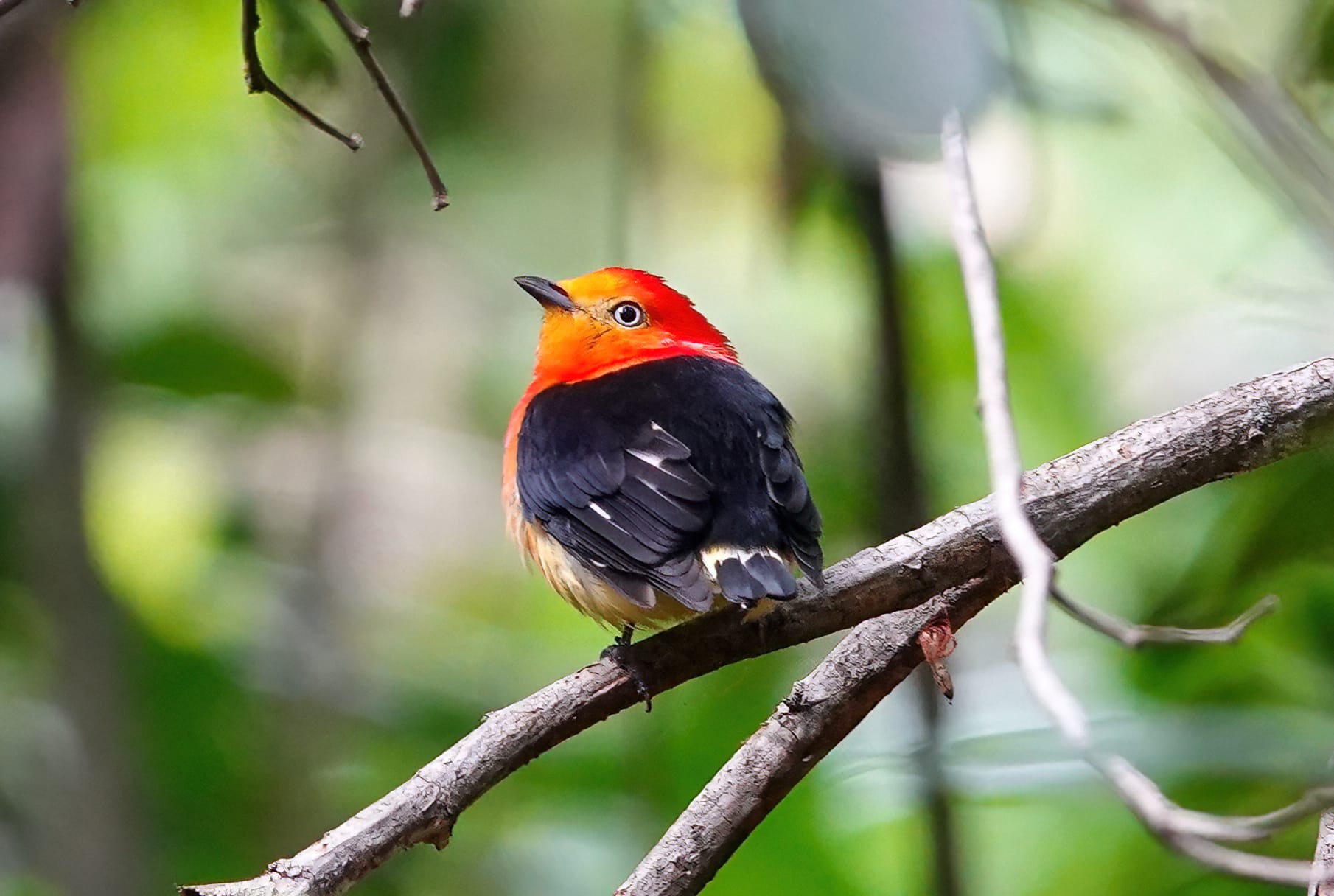
Band-tailed Manakin
identify without expert knowledge and skill. Antbirds (Thamnophilidae which also includes some species like bushbird, bare-eye, fire-eye, stipplethroat), contain about 238 species that include antshrikes, antwrens, antvireos, and antbirds. Add the antpittas, antthrushes and allies, and ant tanagers and the total goes up to more than 360 species!
The highlights were too many to list but included Guianan Cock-of-the-rock, Amazonian Pygmy-Owl, 8 species of Nightjars, Dozens of Antbirds, various Trogans, Tiny Tyrant-Manakin and Wire-tailed Manakin (which although wasn’t a new species for us, is one of the most spectacular Manakins) and birding the Terra firme and flooded forests biomes of the Rio Negro and Amazon rivers.
Day 2– we flew to Manaus and met with our guide Julian. We have birded with him in Argentina and Chile and we were excited to spend some time with him again.
Checked into our hotel and had dinner with Julian to firm up the plan.
Night at Holiday Inn, Manaus
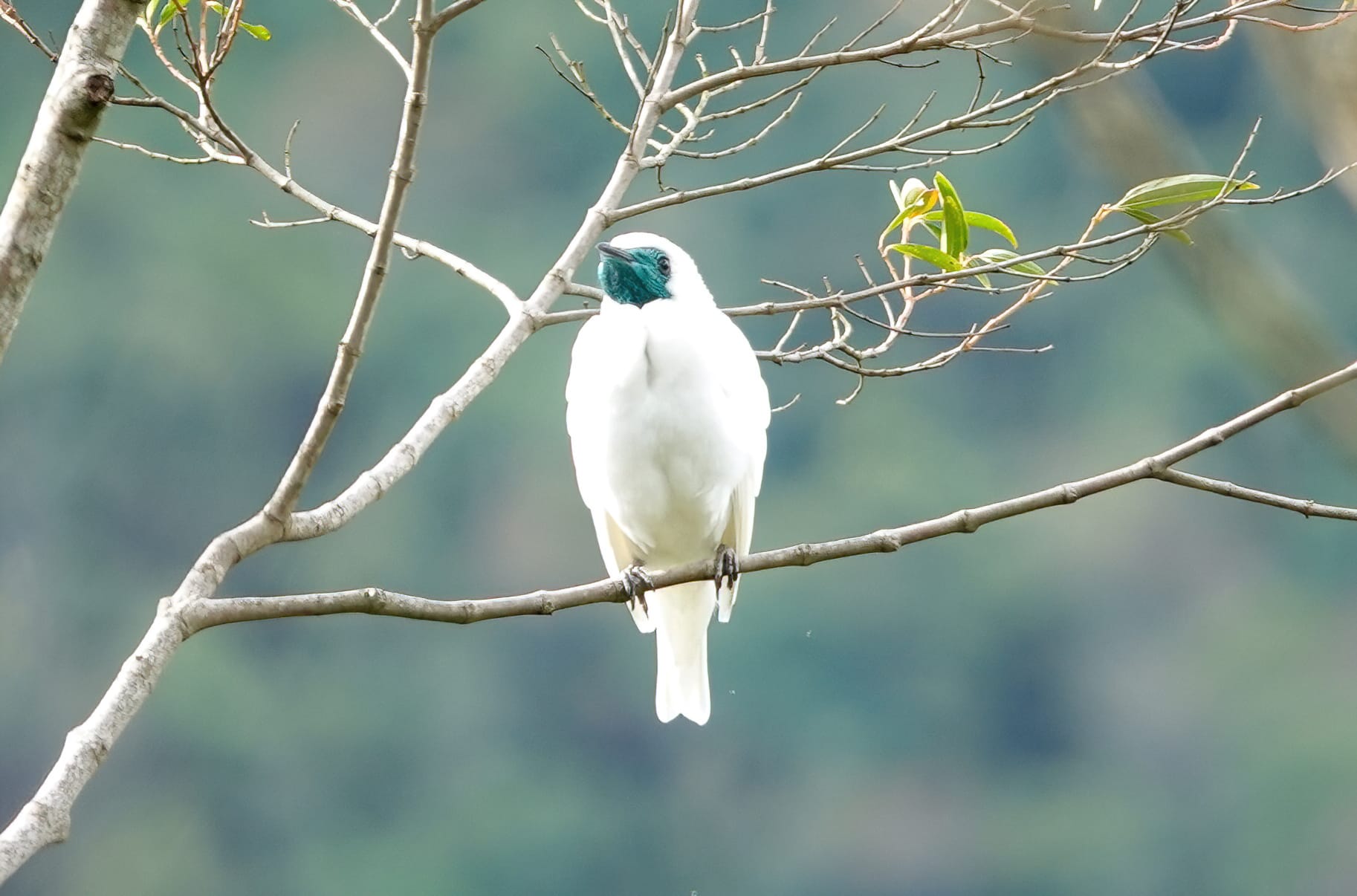
Bare-throated Bellbird
Day 3 – Left super early to drive north toward Presidente Figuiredo but 50 kms out of town we had a flat tyre!!! Changing it wasn’t’ a problem but then we were without a spare so needed to find a solution. We decided we should at least go to our birding spot first and glad we did because it was great.
Our spot was the road leading to the INA Tower – we didn’t bother with the tower – the road was good enough and we had a great 4 hours before the heat became too much. Lifers for us were numerous and Julian did his normal amazing job of identifying every chip to maximize our success.
Black Nunbird, White-throated Toucan, Black Currasow, Black-headed Antbird, Black-spotted Baret, Chestnut-rumped Woodcreeper, Dot-backed Antbird, Glossy-backed (Guianan) Becard, Grey Antbird, Fray Antwren, Great Jacamar, Green Oropendola, Guianan Warbling Antbird, Mouse-colored Antshrike, Pompadour Cotinga, Red-billed Pied Tanager and Short-billed Honeycreeper.
A great start! Then into Presidente Figuiredo to fix the tire – which turned out to be unfixable and we couldn’t buy a new one. We decided to head to the lodge and worry about it later.
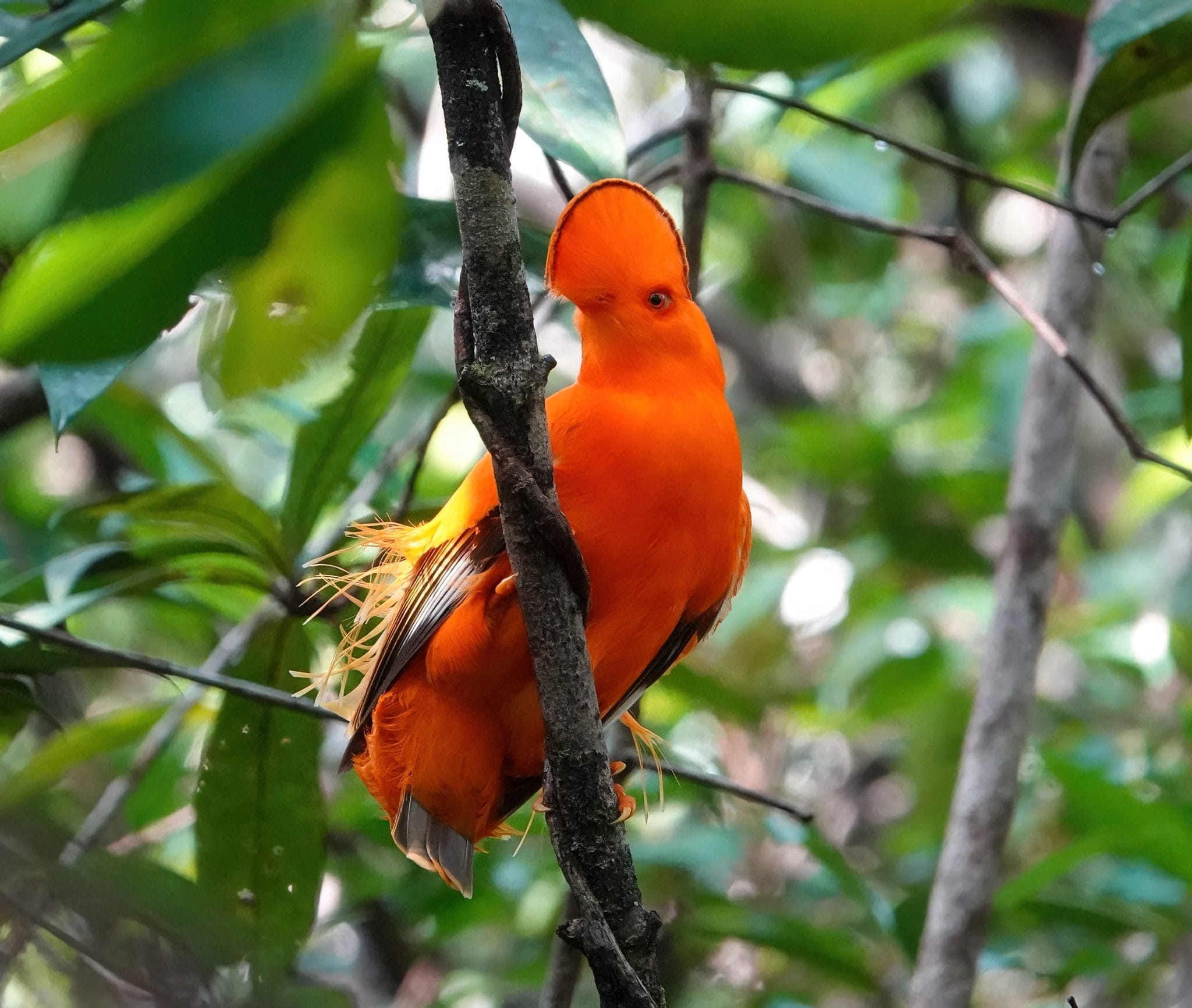
Guianan Cock-of-the-rock
The lodge was quite poor – definitely not being managed at all well but the grounds were quite birdy.
There is a lek for the Guinan Cock-of- the-Rock in the grounds but even if you are staying there they charge you to go in!!
Between the garden and the forest we added another 9 lifers – Broonzy Jacamar, Dusky Parrot, Guianan Cock– of the Rock, Guianan Tyrannulet, Painted Parakeet, White-ore Tyrannulet, Yellow-throated Flycatcher, Helmeted Pygmy Tyrant, and Spot-backed Antwren.
It had been a great day birding and the food at the restaurant was good but the lodge is really bad.
Night at Mari Mari Lodge
Day 4 – Birded the grounds of the lodge in the morning – both in and out of the forest again. And in true Amazonian fashion it provided a whole bunch of different birds. Black mannikin, Black-eared Fairy, Capuchinbird, Maconnell’s Flycatcher, Northern Slaty Antshrike, Pelzen’s Tody Tyrant, Rufous-tailed Flatbill, Rufous-throated Sapphire, Saffron-crested Manakin-tyrant, Spotted Puffbird and Ash-winged Antwren.
A good morning – but then we had to spend the rest of the day driving back to Manaus to change the car. We decided not to make it complete waste of the day and so stopped on our way back up at the same road as yesterday – and so glad we did because we had a whole group of Grey-winged Trumpeters, along with Red-billed Woodcreeper and Blackish Nightjar.

Blond-crested Woodpecker
Night at Mari Mari Lodge
Day 5 – Left early to drive about 45 minutes to another area of Terra Firma forest near Tucumanduba. Yet another great spot and although forest birding is never easy, we eventually had views of Flame-crested Tanager, Waved Woodpecker, Painted Tody-Flycatcher, Caica Parrot, Golden-collared Woodpecker, Guianan Puffbird, Guianan Puffbird, Red-necked Woodpecker, Slaty-capped Shrike-vireo, Variable Chachalaca, Wing-barred Piprites, and Yellow-throated Woodpecker.
Back for lunch and a siesta before birding the grounds again. We wanted another look at the Cappuchinbird which was great but the forest was pretty quiet. However, there was a tree by the restaurant that was full of hummingbirds and we added Crimson Topaz and Butterfly Coquette to our list.
Night at Mari Mari Lodge
Day 6 – Headed back up to the forest near Tucumanduba. It was raining on and off but in between we managed Black-bellied Cuckoo, Dotted tanager, Ferruginous-backed Antbird, Guianan Toucanet, Rufous-throated Antbird, Olive-green Tyrannulet, Pearly Antshrike and Leaden Antwren.
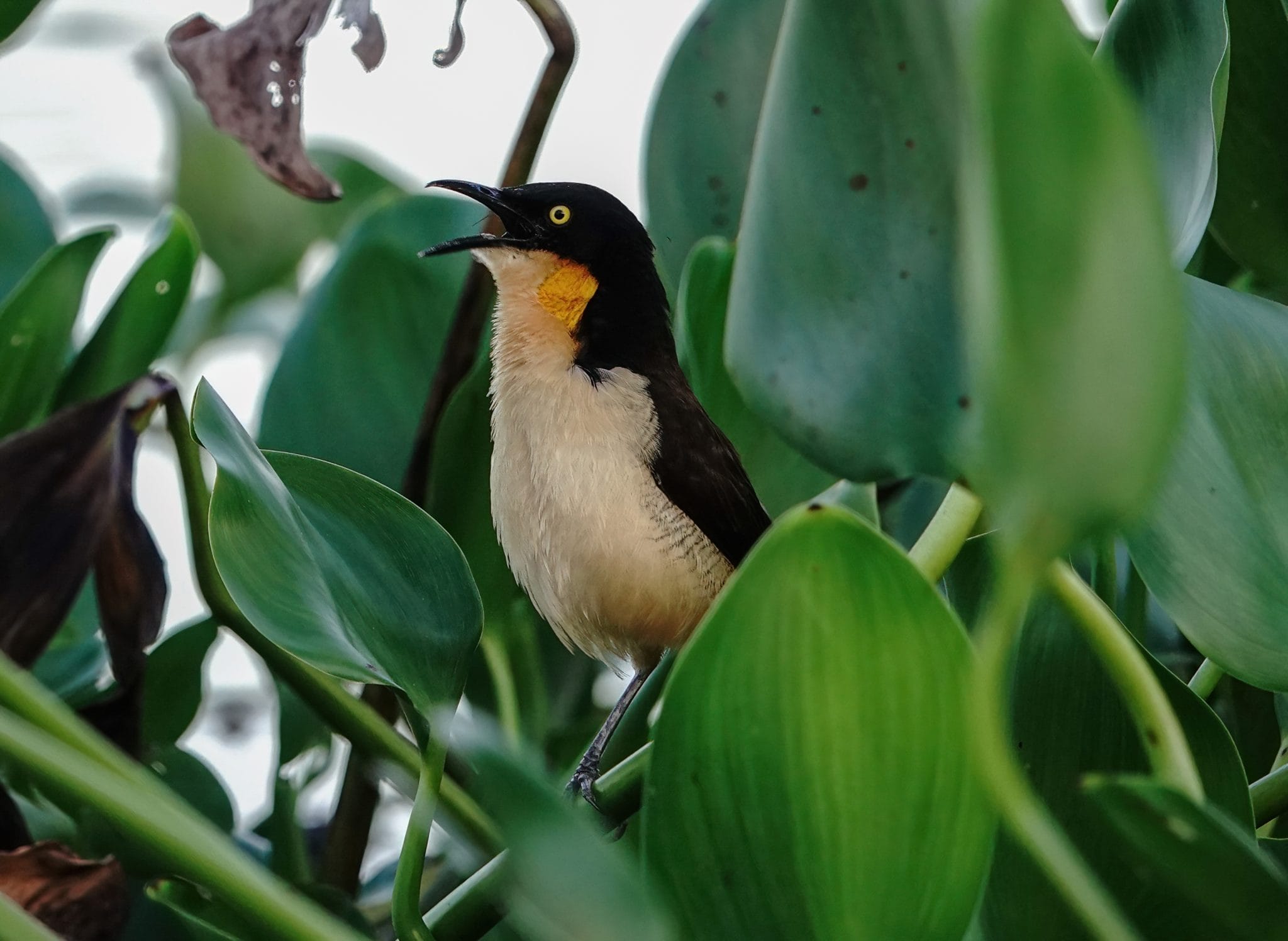
Donacobious
We started heading back to the lodge to collect our bags but the road was so birdy after the rain that it took us hours! There were dozens of Blue & Yellow, Red-bellied and Scarlet Macaws. Blue-headed parrots by the dozen and lifers for us of Red-Fan Parrot, Green-necked and Black-necked Aracaris.
Collected our bags and spent the afternoon driving down through Manaus and onto our next lodge in Manacupuru.
Night at Cirandeira Amazon World EcoResort
Day 2– we flew to Manaus and met with our guide Julian. We have birded with him in Argentina and Chile and we were excited to spend some time with him again.
Checked into our hotel and had dinner with Julian to firm up the plan.
Night at Holiday Inn, Manaus

Great Potoo
Day 7 – Woke up not feeling great but went out to bird the grounds before breakfast. This is quite a strange lodge – good rooms and restaurant but there are load of statues in the forest and some of them are making noises, which is a bit disruptive when birding. We did manage Spot-backed Antwren, Blue-backed Manakin, Dwarf Tyrant Manakin, Yellow-browed Antbird and Collared Gnatwren.
We went back to bed for a couple of hours before lunch and then continued on our way to Nova Aireo and our next lodge.
Birded the grounds here before dinner – quite a few birds and added Green-throated Mango and Snethlage’s Tody-tyrant.
Night at Amazonia Part & Suites. Novo Airao
Day 8 – It was really raining this morning, but we headed out to the forest and managed to get some birding in. The open areas were better than the forest ( which basically produced nothing) and 30 minutes birding from the car produced Yellow-margined Flycatcher, Grey-lined Hawk, Channel-billed Toucan and Lined seedeater.
The afternoon birding wasn’t much better so quit after a few hours and went back to get beer.
Night at Amazonia Part & Suites. Novo Airao
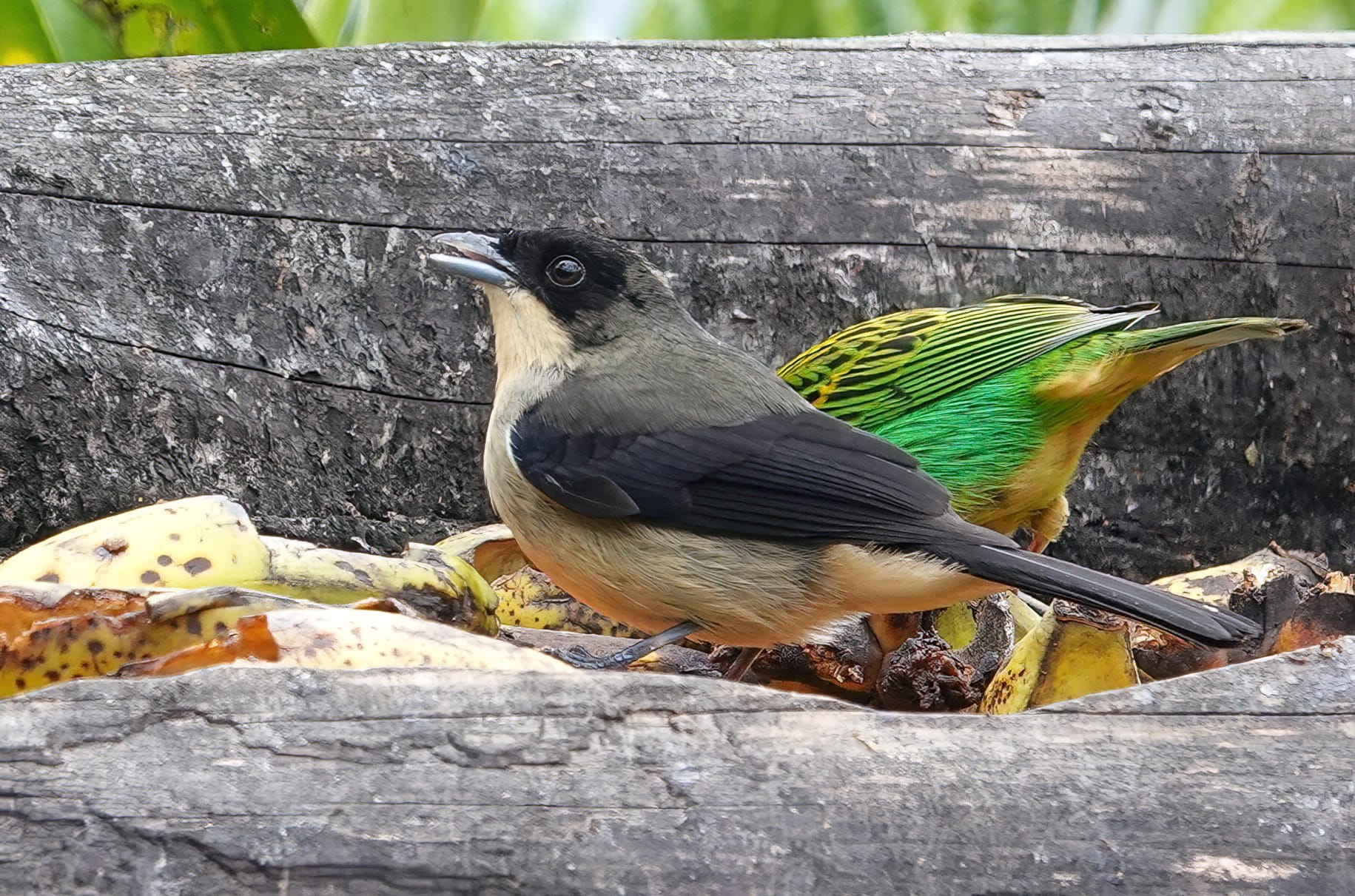
Black-goggled Tanager
Day 9 – Great morning. We took a boat out onto the Rio Negro to check out the islands and it was fantastic. Just birding from the boat at the first stop gave us 8 lifers – Ash-breasted Antbird,
Klage’s Antwren, Black-chinned Antbird, Yellow-sided (Riverside) Flycatcher, Blackish-grey Antshrike, Grey-breasted Greenlet, Streak-throated Hermit and Blue-chinned Sapphire.
It was soi peaceful on the water and there was very little other boat traffic so it was really quite idyllic. The next spot gave us Orange-crowned Yellow-finch, Rusty-backed Spinetail, Cherri’s Antwren and Ringed Woodpecker.
Then we got off the boat at a spot for a Wire-tailed Manakin lek. The birds were there and it was spectacular. Not new for us but any opportunity to see a bird like this is fabulous.
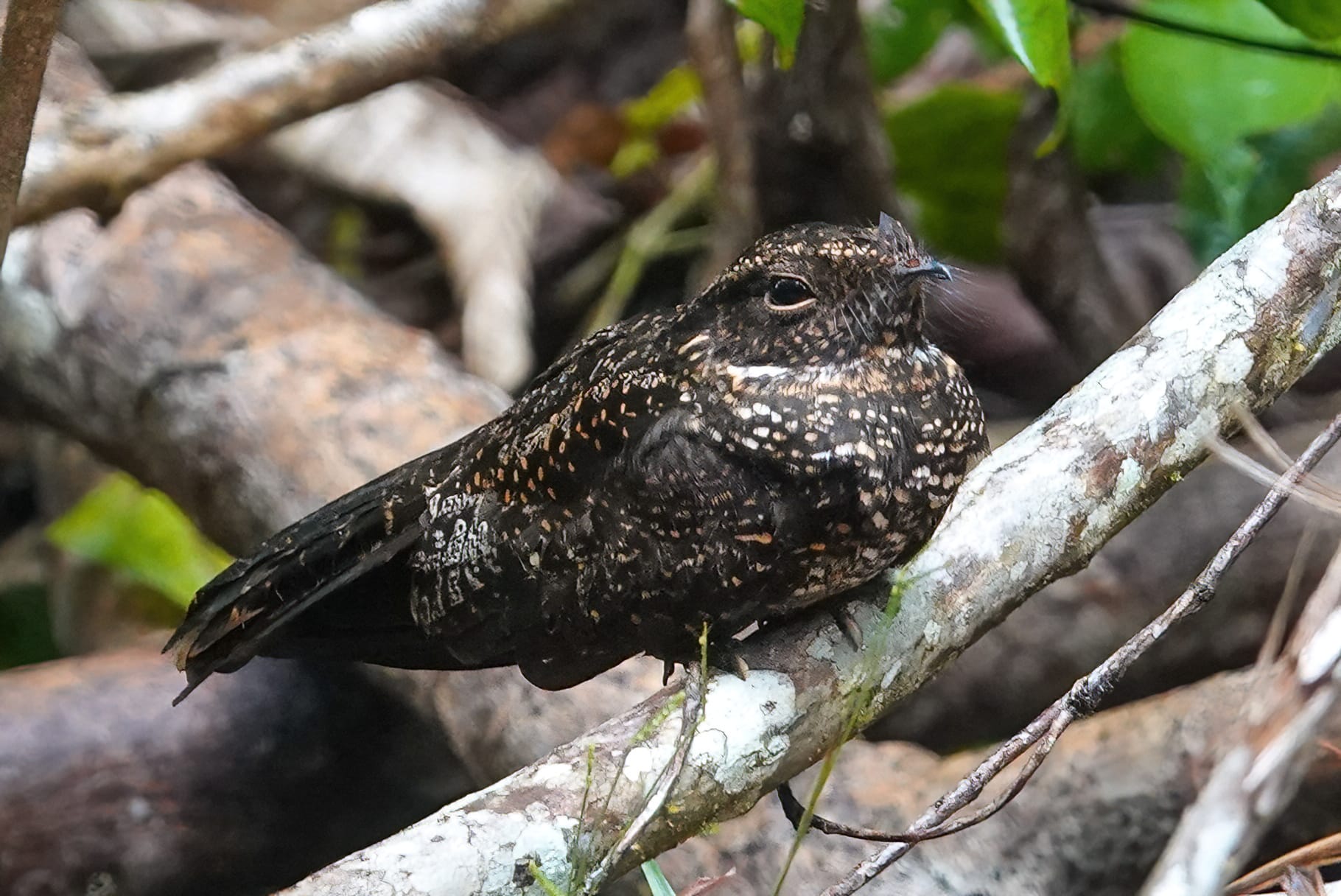
Blackish Nightjar
After lunch and a rest, we were back out on the boat. Fairly quiet but lovely. The only lifer before dusk was Anazomian Ineza – but then the nightjars came out and they were fantastic. Band-tailed Nighthawk was new for us and we had great views.
Night at Amazonia Part & Suites. Novo Airao
Day 10 – Another great day on the river. It was quite an adventure to get to our birding spot because the water level was quite low and our boatman had to literally drag the boat along in a couple of spots – but it was worth it. It was a private forest reserve and quite birdy. White-crested Spadebill, Yellow-crested Manakin, Buff-throated Woodcreeper, White-chinned Woodcreeper, Long-winged Antwren, Rufous-backed Stipplethroat, Epaulet Oriole and Brown Twistwing.
Wonderful morning and a great siesta!!
Once again the afternoon boat ride was quite quiet until the nightjars all came out but we did get an olive Oropendola for the list.
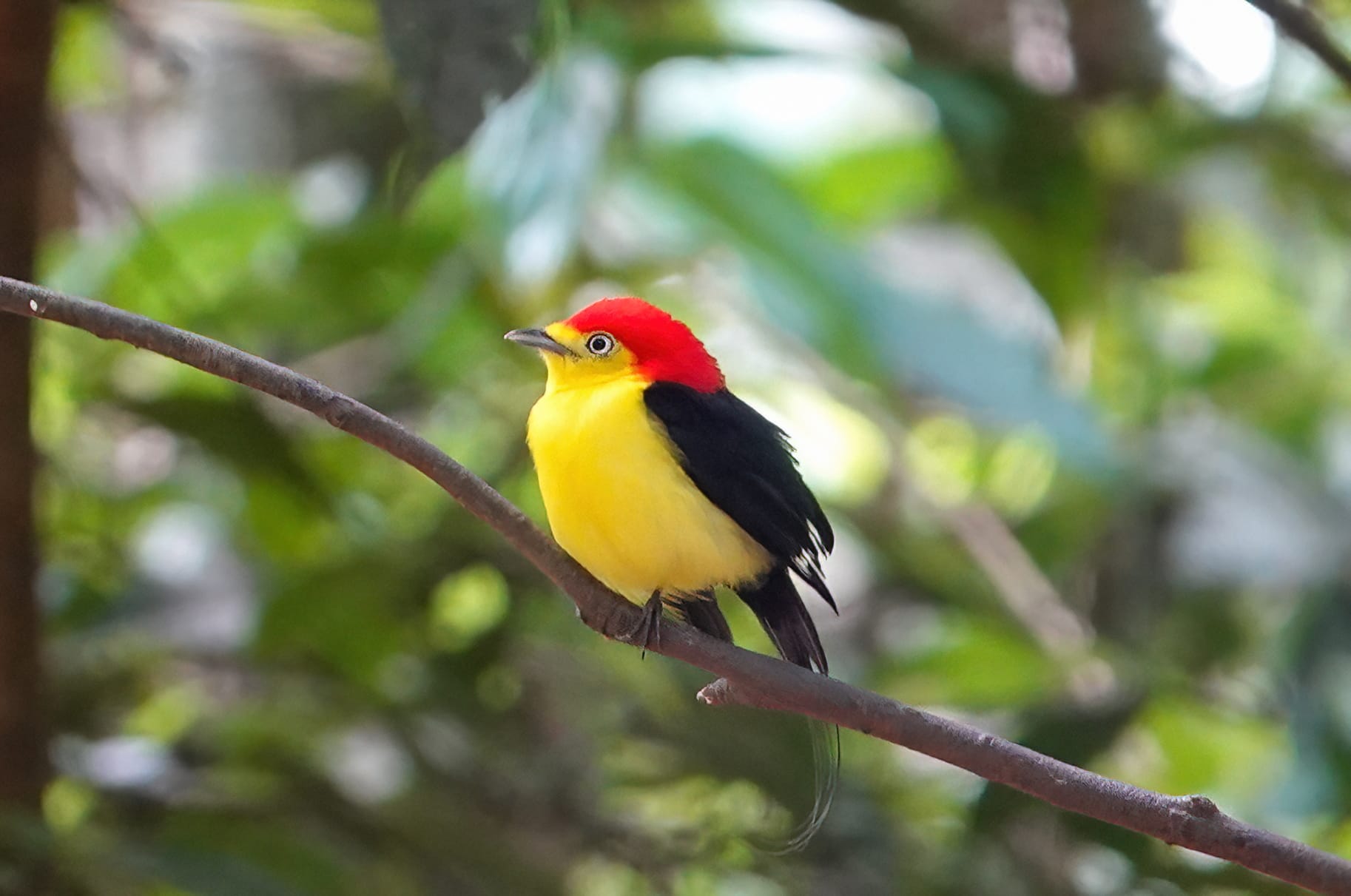
Wire-tailed Manakin
Night at Amazonia Part & Suites. Novo Airao
Day 11 – We decided to take the day off today and just relax – it was blissful – caught up on email , the bird list and the journal.
We had set the evening aside to go for potoos and so had an early dinner and drove out. We heard both White-winged and Rufous Potoo but, unfortunately, no sightings!
Night at Amazonia Part & Suites. Novo Airao
Day 12 – Our final trip on the Rio Negro – went even further into the islands and landed at a great spot. Spent several hours walking on a trail through the forest and found quite a few birds Amazonian Pygmy-owl, Cocoa Thrush, Golden-sided Euphonia, Rufous-bellied Antwren, Stipple-throated Antwren, Tiny Tyrant-Manakin.
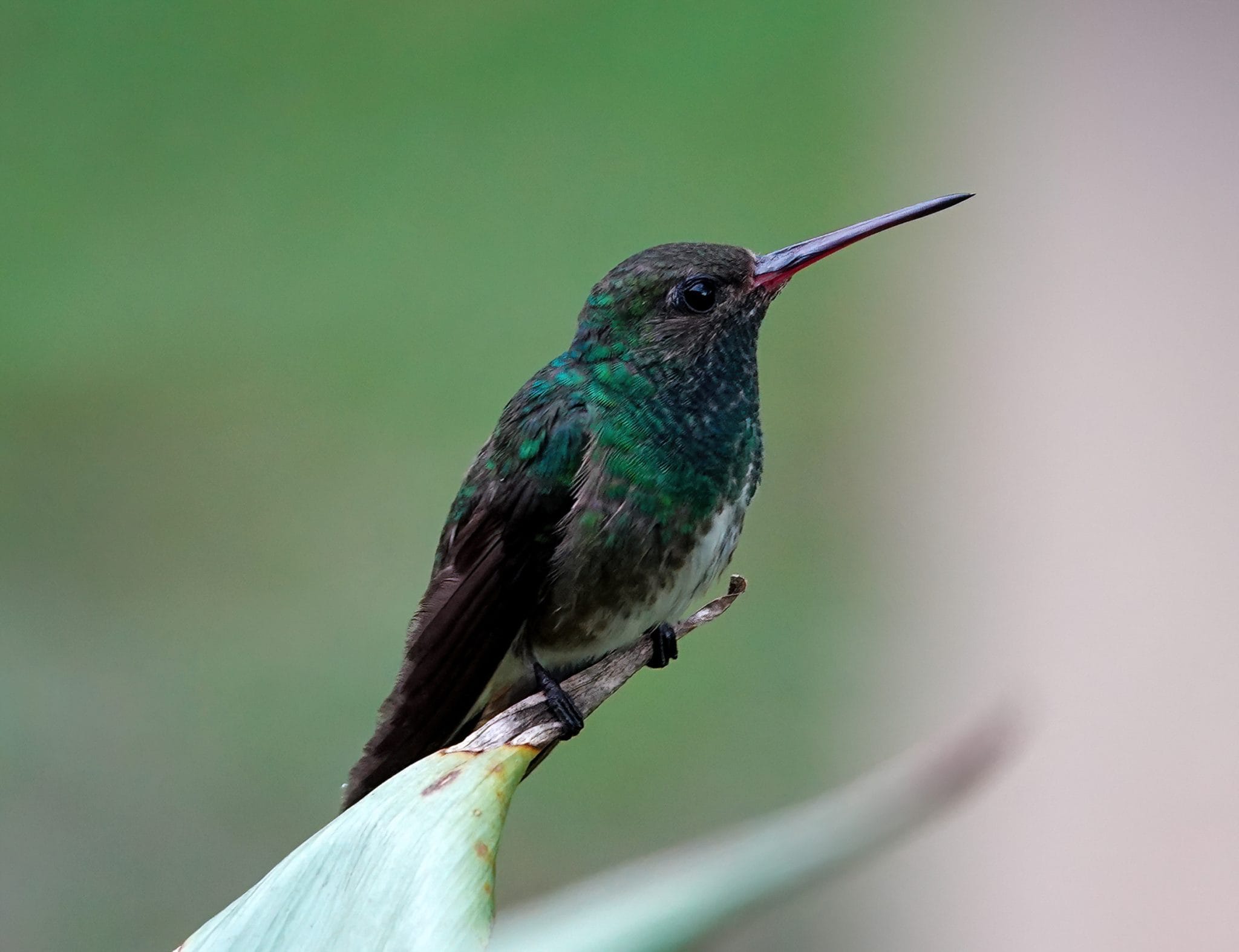
Glittering-throated Emerald
Quite a challenging trail but worth it.
After lunch we packed up and drove back to Manaus. A couple of stops along the way were good spots and we added Golden-winged Parakeet and Green-tailed Goldenthroat.
Night at Novotel, Manaus
Day 13 – Today it was a boat to the islands off Manaus that are at the confluence of the Rio Negro and Amazon Rivers. Once again, the river level was very low so we could walk on the islands and it was unbelievably birdy. We actually had 91 species in the time we were out on the water. We thoroughly enjoyed ourselves – only 5 lifers but a really enjoyable experience. Wing-banded Hornero, River Tyrant, Red& White Spinetail, Pearly-breasted Conebill and Masked Yellowthroat. What a great way to end this part of our trip.
Night at Novotel, Manaus
Day 14 – just a travel day to Rio de Janeiro. Night at the Linx Hotel
The Atlantic Forest
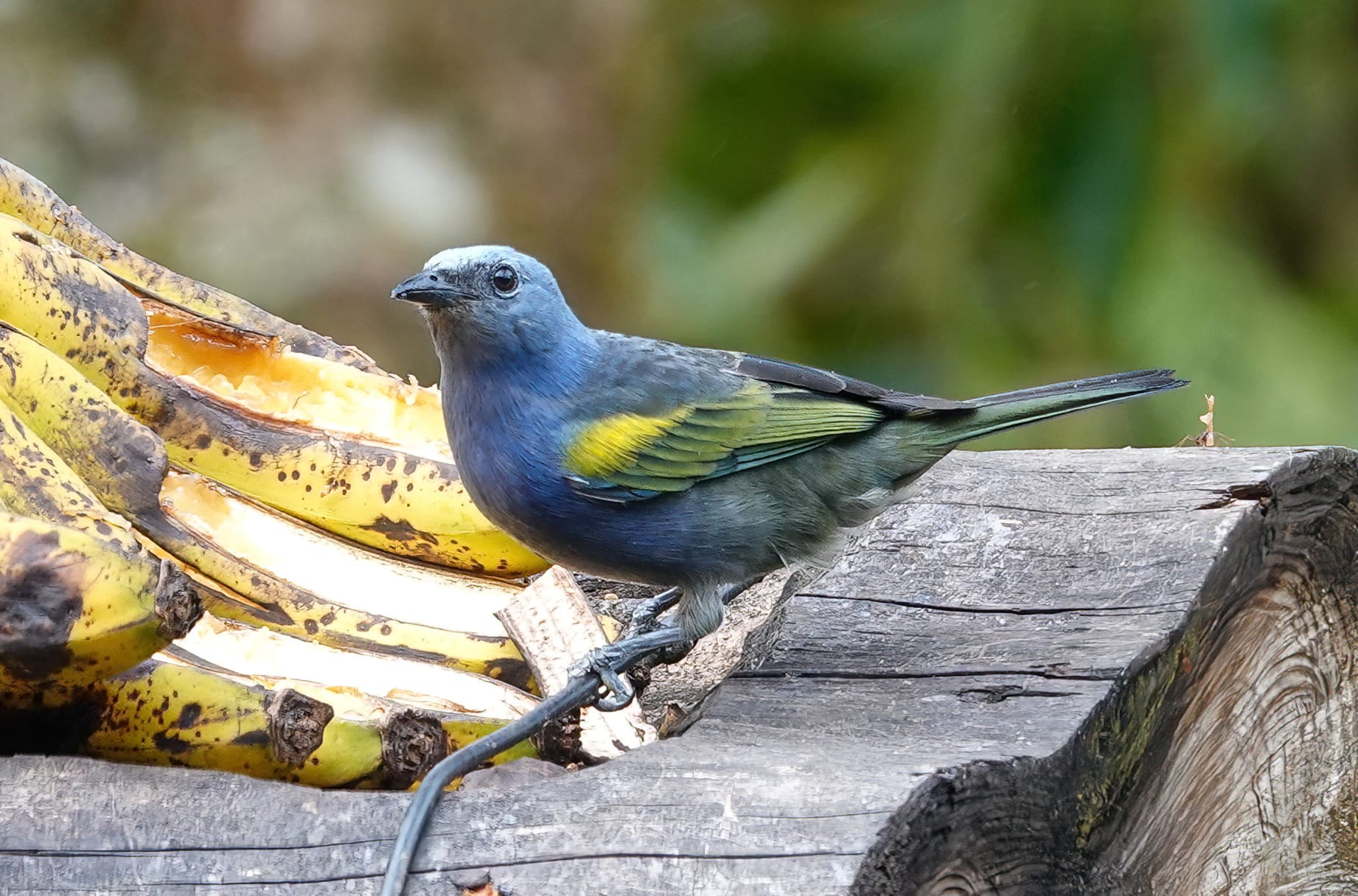
Golden-chevroned Tanager
Birding in the Atlantic Forest was somewhat easier after the extreme birding experience in Manaus. We birded the restored and native forest wetlands and the Serra dos Órgãos mountains, part of the larger mountain complex called Serra do Mar in south-eastern Brazil.
With a wide latitudinal distribution and a wide altitudinal range due to the mountainous topography of the region, the geographic isolation has produced a rich biodiversity, with an exceptionally high level of endemism and of the 682 bird species, some 199 (29%) are endemic to the Atlantic Forest with a dazzling display of euphonias, chlorophonias and tanagers including Brazilian, Swallow, Flame-crested, Golden-chevroned, Burnished-buff and Yellow-backed. Hummingbird diversity includes Swallow-tailed, Rufous-breasted Hermit, Reddish Hermit, White-chinned Sapphire, Black Jacobin, Violet-capped Woodnymphs, and Glittering-throated Emeralds among others.
The wide variety of species further includes Black-legged Dacnis, Rusty-margined Guan, Maroon-bellied Parakeet, Ferruginous Pygmy-Owl, Rufous-tailed Jacamar, Rufous-thighed Kite, Channel-billed Toucan, Blond-crested Woodpecker, Chestnut-backed Antshrike, and Long-billed Wren, and at night, Tawny-browed Owl, Tropical-Screech-Owl, Potoos and Pauraque.
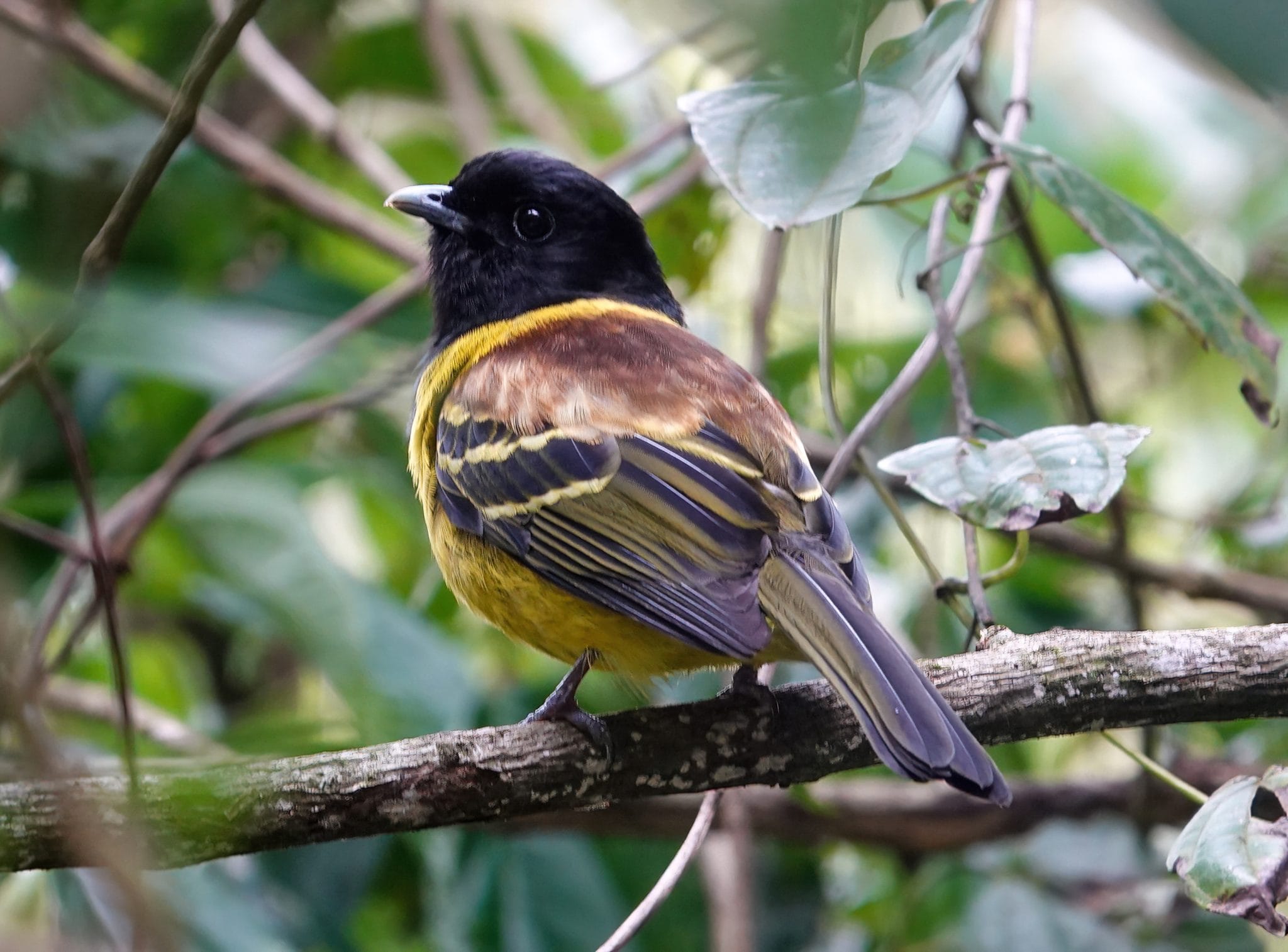
Hooded Berryeater
The highlights here were equally many but the endemic Long-trained Nightjar is easily the most spectacular nightjar we have ever seen!
Day 15 – We rented a car and drove out to REGUA. The scenery on the way out was spectacular. REGUA is great – we had the place to ourselves for the first couple of days and they made us feel very welcome.
They have great feeders in the garden and we enjoyed Brazilian Tanagers, Rusty Margined Guan, Sooretama Antshrike and Violaceous Euphonia over lunch.
We did a late afternoon excursion with the local guide for Giant Snipe, which was fabulous and also got Burnished Buff Tanagers and Long-billed Wren.
Night at REGUA
Day16 – It was really nice birding here because we didn’t have to start until 6.30. It was a nice day and we went with the local guide to the Waldennor Trail. It was quite long and uphill but really quite birdy and our life list was long.
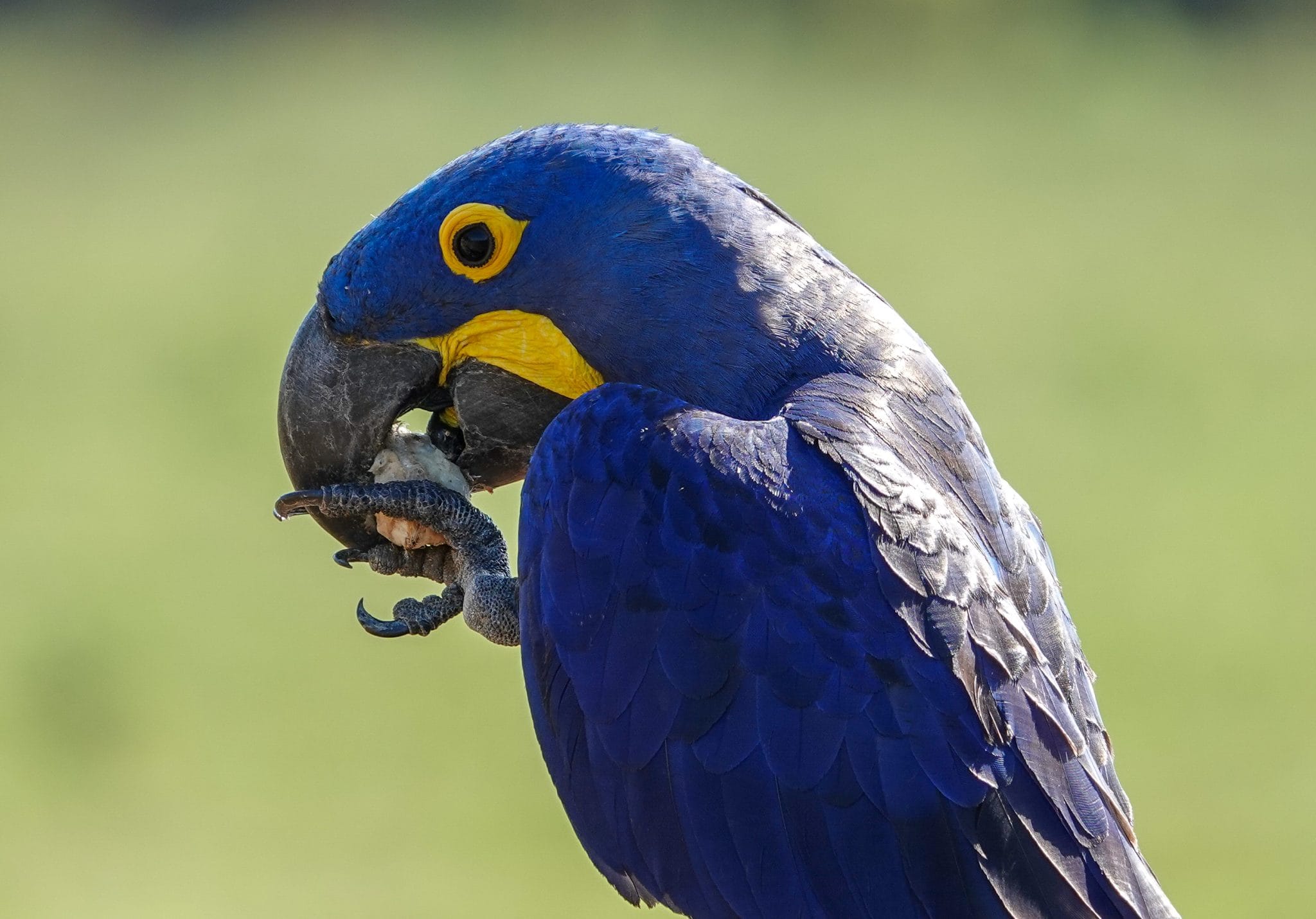
Hyacinth Macaw
Moustached Wren, Yellow-green Grosbeak, Asure-shouldered Tanager, Golden-chevroned tanager, Rufous-headed tanager, Olive-green Tanager, Pin-tailed Manakin, Unicolored Antwren, Spot-breasted Vireo, Black-capped Foliage-gleaner, Thrush-like (Plain-winged) Woodcreeper, Yellow-eared Woodpecker, Spot-billed Toucanet, Silvery-flanked Antwren, Frilled Coquette, Sick’s Swift, Least Pygmy-owl, Blue-winged Macaw and Bicustate Swift.
What a day!
In the afternoon we went down to the wetland area near the lodge and managed Rufous-sided Crake.
Night at REGUA
Day 17 – It was rather rainy today so we went with the local guide and decided to start with a drive around the open fields. Managed Red-cowled Cardinal and Curl-crested Jay before deciding to try the Green Trail. We didn’t get very far before the heavens opened but did manage to see Gray-hooded Attila and Whiskered Flycatcher before calling it a day.
In the afternoon we went out on our own to try for Ash-throated Crake – which meant we ended up with 5 life birds despite a challenging day.

Ladder-tailed Nightjar
Night at REGUA
Day 18 – the rain was hanging around again but went for the Green Trail anyway – and really glad we did. It just drizzled a bit but we made it all the way to waterfall at the end of the trail – about 4 km in each direction.
Red-necked Tanager, Star-throated Antwren, White-eyed Foliage-gleaner, Eye-ringed Tody-Flycatcher, Rufous-breasted Leaftosser, Scaled Antbird, Lemon-chested Greenlet, Black-cheeked Gnateater, Bare-faced Bellbird and Grey-hooded Flycatcher.
Decided to chill in the afternoon. After dinner, a female tapir walked out on to the lawn – with a baby – it was spectacular.
And then to top it all off we got Tawny-browed Owl before bed.
Night at REGUA
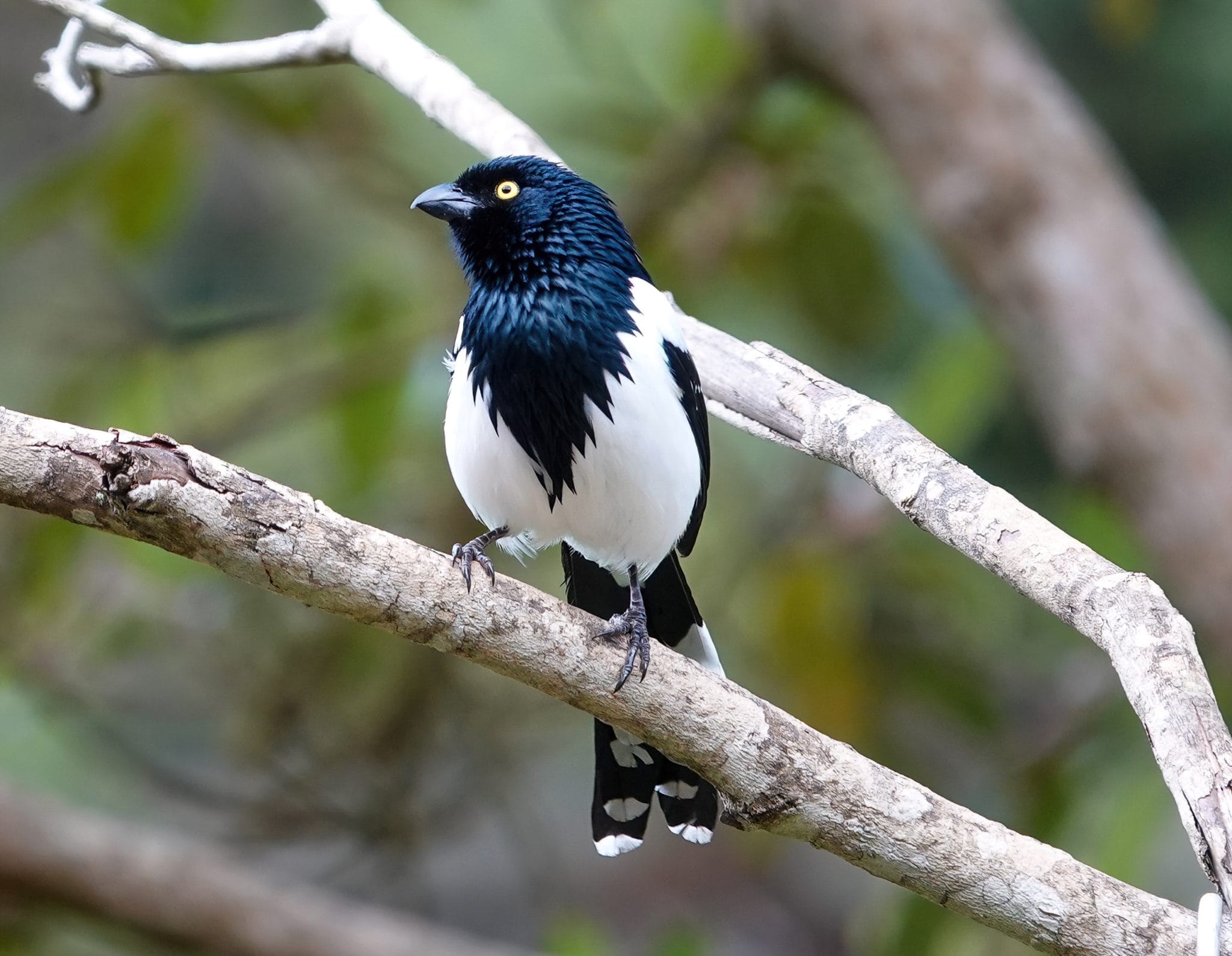
Magpie Tanager
Day 19 – We went up to Vale de Revolta today. We didn’t have a guide but an English volunteer from the reserve came with us. It is an easy place to walk around, although not overly birdy. We were thrilled, however, to get Green-backed becard, Sooty Grassquit, White-bibbed Antbird, Ferruginous Antbird and Planalto Tyrannulet.
Back to REGUA for lunch and then packed up and drove up to Itororo Ecolodge. It was an interesting road to get to the lodge and we were beginning to get a bit nervous about what we were actually going to find at the end – so we were really pleasantly surprised when we arrived.
The feeders were really busy so we sat and enjoyed them before dinner. Brassy-breasted and Gilt-edged Tanagers were new for us.
Night at Itororo Eco-Lodge
Day 20 – Met our new guide, Gabriel, at breakfast and decided to spend the day trying for some lowland species that we hadn’t yet managed a REGUA.
Went to other parts of Tres Picos and Gabriel worked hard to add more lifers to our list. Atlantic Plain Xenops, Saw-billed Hermit, Rufous-capped Antthrush, Rough-legged Tyrannulet, white-collared Foliage-gleaner, White-browed Foliage-gleaner, Atlantic Black-throatd Trogon, White-browed Warbler, Sharpbill, Pallid Spinetail, Plovercrest and Hooded Berryeater.
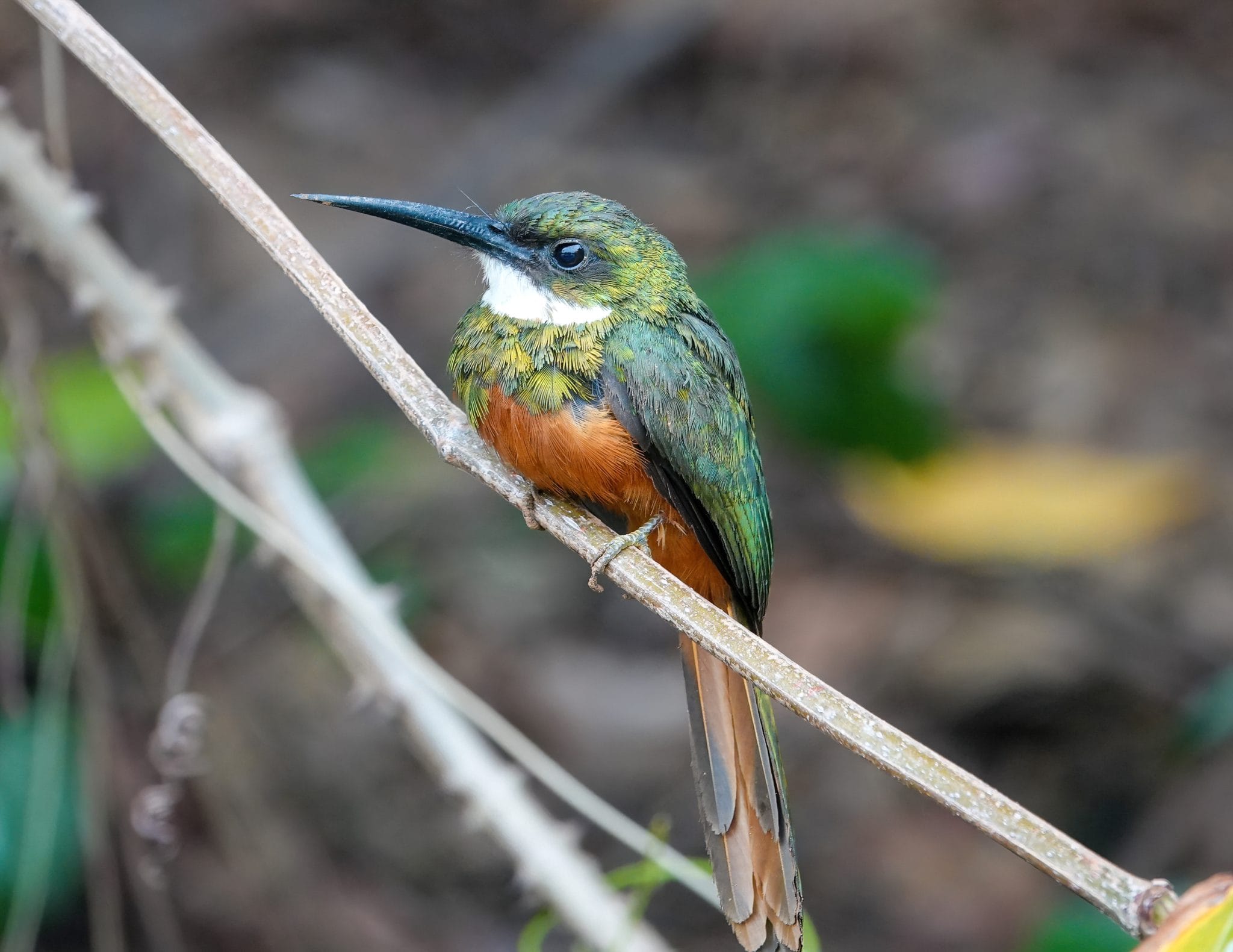
Rufous-tailed Jacamar
It was a long day but Gabriel was a great guide and we really enjoyed it.
Night at Itororo Eco-Lodge
Day 21 – Today we had Gabriel’s twin brother, Daniel, as our guide and we headed up to Caledonia. We spent the whole day there and it was fabulous – the change of altitude was really productive.
Brazilian Ruby, Gry-capped Tyrannulet, Black & Gold Cotinga, Grey-winged Cotinga, Blue-billed Black-Tyrant, Rufous-tailed Antthrush, Mouse-colored tapaculos, Bay-breasted Warbling-finch, Rufous-backed Antvireo, Oreange-eyed Thornbird, Serro do Mar Bristle-tyeant, Cinnamon tanagr, Itaiti Spinetail, Shear-tailed Gray tyrant, Large-tailed Antshrike, Slaty Bristlefront, Mantled Haw, Ochre-rumed Antbird, Rufous-tailed Antbird, Camp Flicker, thick-billed Saltator and Scaled Woodcreeper.
Back to the lodge and managed Tropical Pewee and Rusty-barred Owl before dinner.
Night at Itororo Eco-Lodge
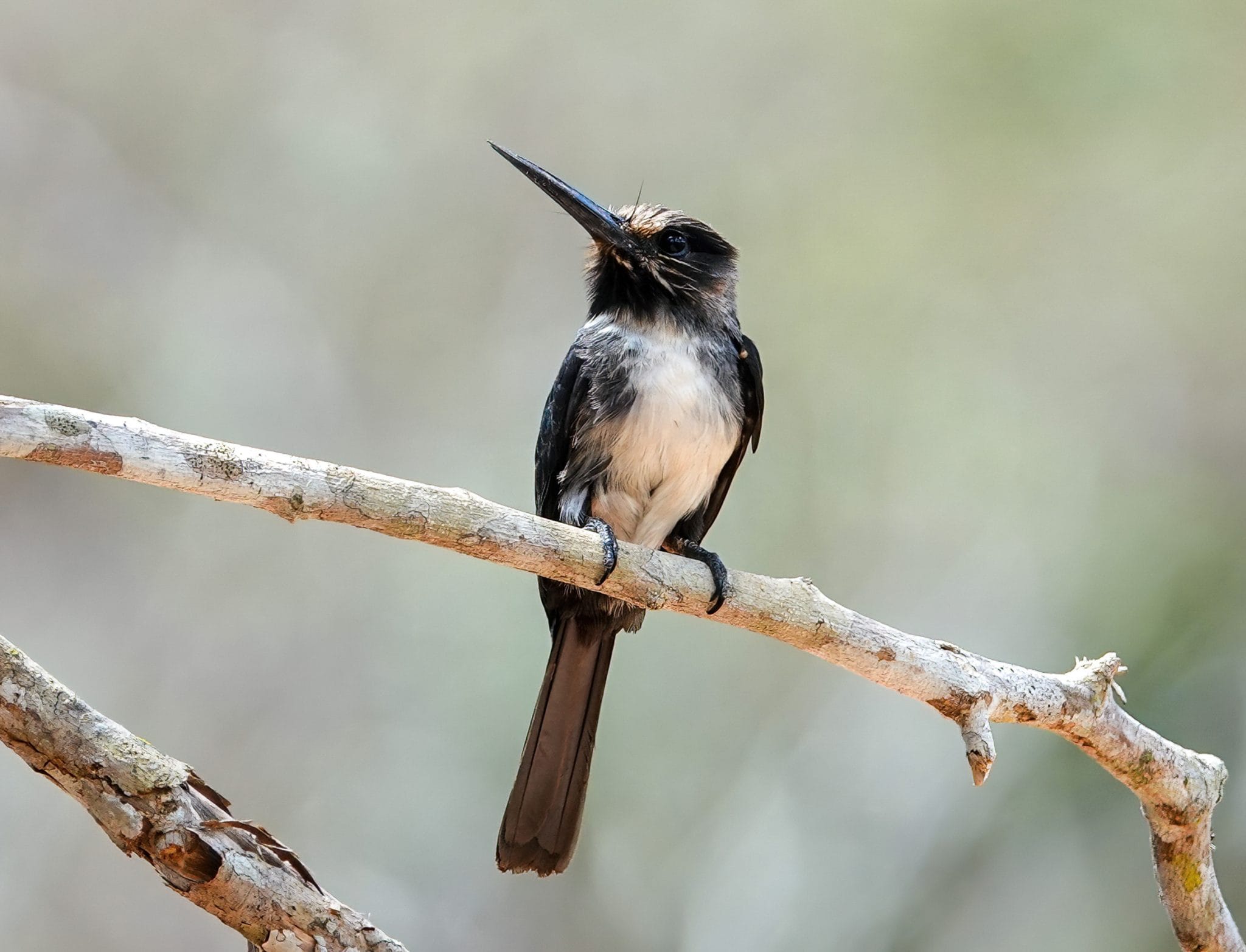
Three-toed Jacamar
Day 22 – Another day with Daniel and it started well with Saffron Toucanets from the deck of our chalet. Then it was out to some dry forest for even more great birding. Amethyst Woodstar,
White-rumped Monjita, Gray Monjita, White-eared Puffbird, Serro do Mar Tyrant-Manakin, Crested Black-tyrant, Cobalt-rumped Parrotlet, Serra Antwren, Three-toed Jacamar, Chestnut-backed Antshrike and Hangnest Tody-tyrant, Rio de Janeiro and White-bellied Seedeater.
Back to the lodge for an amazing Long-trained Nightjar before dinner.
Night at Itororo Eco-lodge
Day 23 – Our last morning at Itororo so we decided to take our breakfast down to the hide. It was great – all sorts of birds turned up including Brown Tinamou, Spot-winged Wood-quail and Such’s Antthrush.
Then drove back down to Rio for a few days R&R.
Night at MGallery Sanata Teresa.
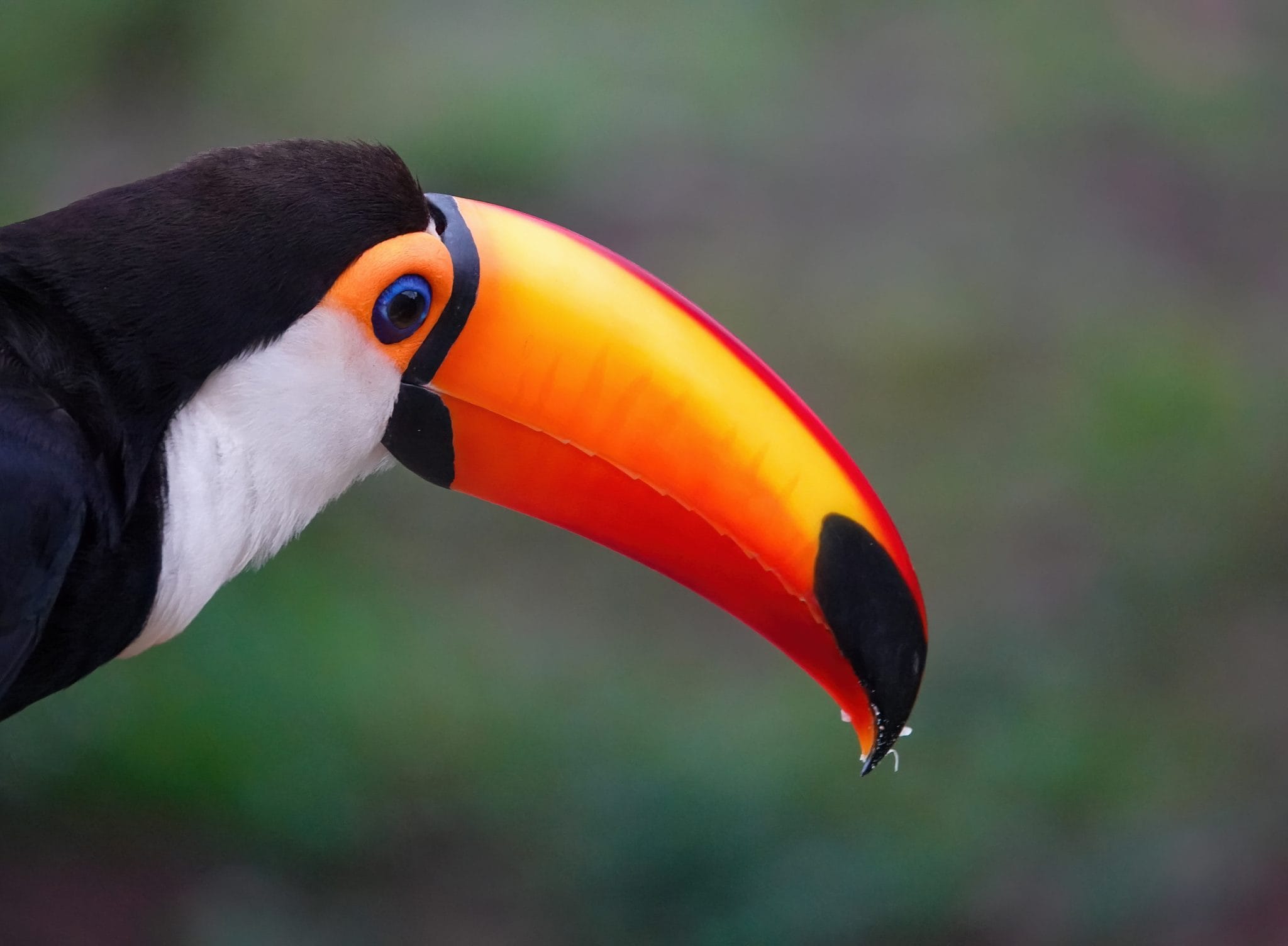
Toco Toucan
Day 24, 25 and 26 – We just hung out in Rio and then flew to Campo Grande where we were met and driven to Pousada Aguape for the next 5 nights.
The Pantanal
The Pantanal is the world’s largest tropical wetland covering an area of around 180,000 square kilometers, making it one of the most biologically diverse places on Earth. Its open landscapes provide relatively easy birding compared to the dense Amazonian rainforests we had birded previously on this trip.
The ecosystem is defined by seasonal flooding during the rainy season when up to 80% of the area can be submerged. It is a biodiversity hotspot with more than 1,000 species of birds recorded, and has the highest density of the iconic Jaguar and is considered the best place to see them in the wild, along with Caiman, Capybaras, Giant River Otters, South American Tapirs, Giant Anteaters, and Maned Wolves.
Again, birding highlights were many and watching a female Jaguar hunt Capybaras was an experience we will never forget (video).
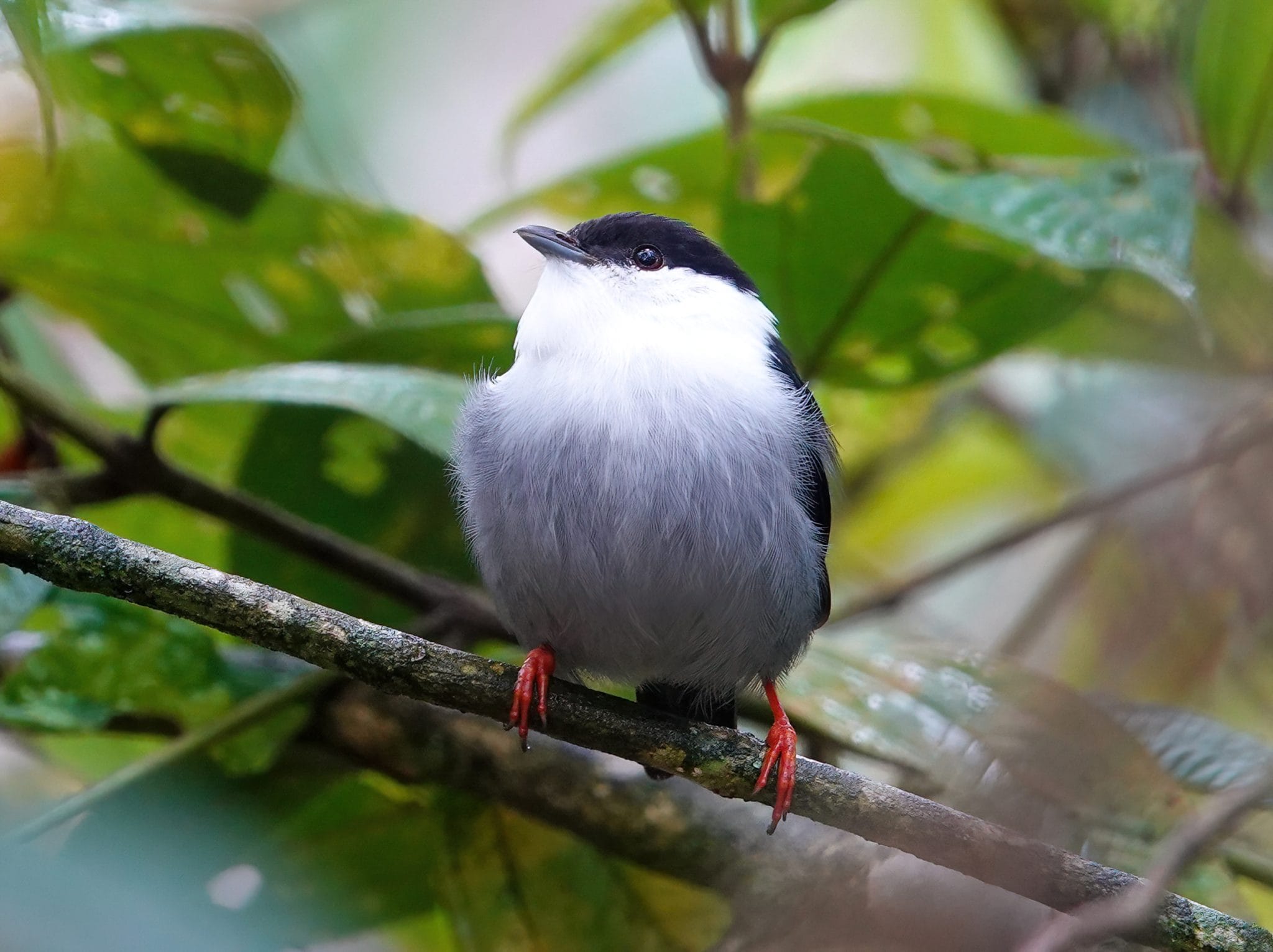
White-bearded Manakin
Day 27,28,29,30 – We had a private guide and driver and spent 4 days covering various habitats at Pousada Aguape – several boat rides and both forest and grassland. The guide wasn’t really a bird guide but over the 4 days he managed to find most of the species we were looking for and we ended up with 30 life birds.
Bare-face curassow, Black-throated Saltator, Blaze-winged Parakeet, Buff-bellied Hermit, Chaco Chachalaca, Chestnit-crowned Foliage-gleaner, Fawn-breasted Wren, Flavescent Warbler, Great Potoo, Great Rugous Woodcreeper, Helmeted Manakin, Hyacinth Macaw, Long-tailed Ground-dove, Mato Gros Antbird, Nanday parakeet, Oreange-backed Troupial, Pale-crested Woodpecker, Peach-fronted Parakeet, Plain Tyrannulet, Red-shouldered Macaw, Rufous Cachaote, Rufous Caiornis, Saffron-billed Sparrow, Spot-backed Puffbird, Blue-fronted Parrot, Undulated Tinamou, White-lored spintetail, White-throated Piing-guan, White-wedged Piculet and Yellow Collared Macaw – pretty good.
The birds around the feeders at the lodge were spectacular and the armadillos that wandered around everywhere were really cute. We also saw several Giant Anteaters, one with a baby on her back!
But don’t go here for jaguars – they really only see them once or twice a year!
Night at Pousada Aguape
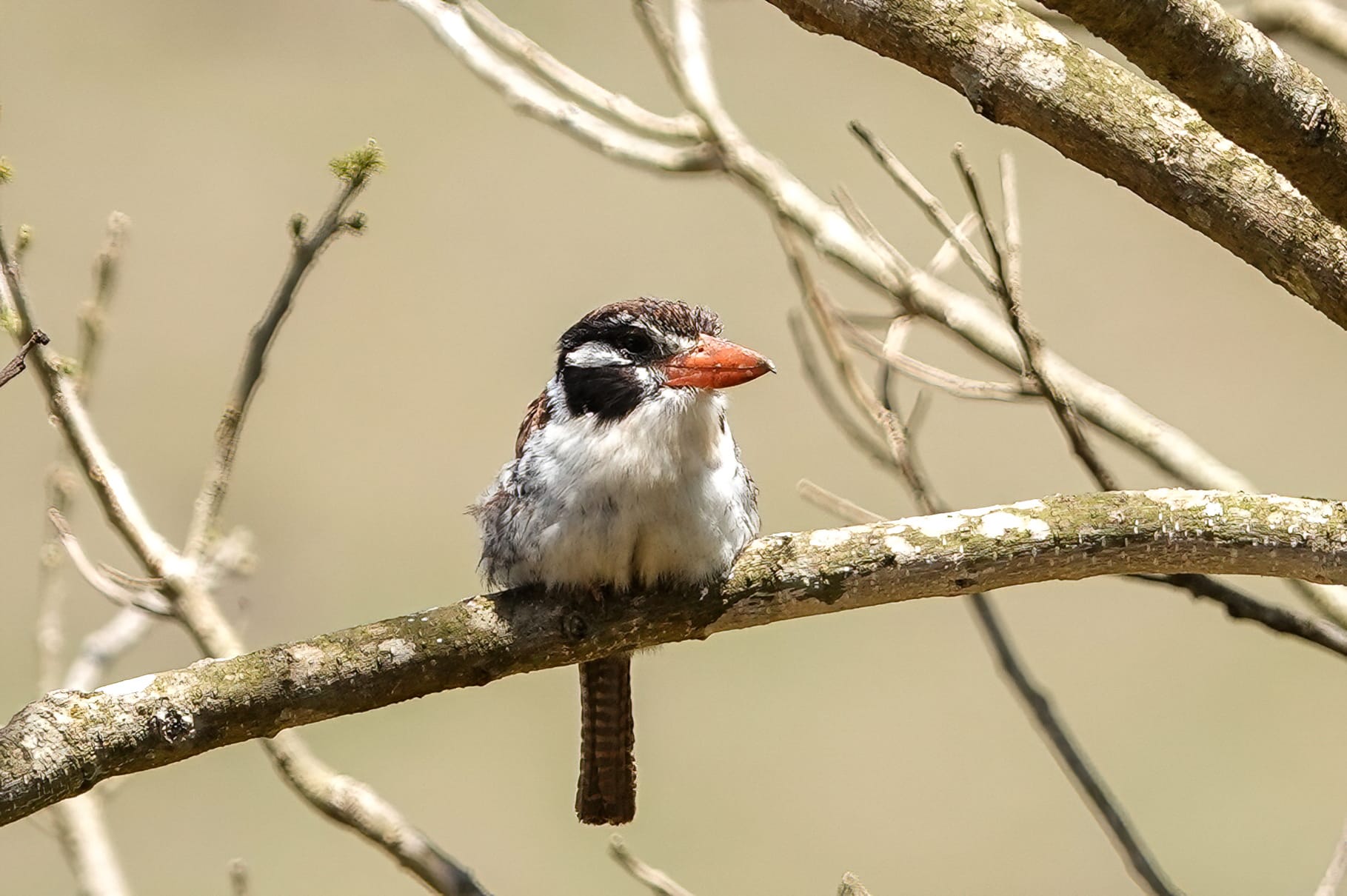
White-eared Puffbird
Day 31,32,33, We then moved onto Cuiaba for a different part of the pantanal,
Cuiaba itself was the nicest town we had seen in Brazil but the drives to get to the wildlife were long.
We had done this whole section with a group called SouthWild and I would avoid them – there were too many negatives to list here!
First stop was half way to Porto Jofre. We arrived at Southwild Pantanal Santa Tereza Lodge and checked in for the night. We discovered we didn’t have a bird guide despite requesting one a year ago so the birding was painful for the next few days. Luckily, we knew enough and with the help of Merlin I don’t think we mis-identified anything but in terms of locating the specialties we just had to trip over them as he didn’t know where to find them.
Our first day was quite dull with an uneventful boat trip in the morning and a quiet walk in the
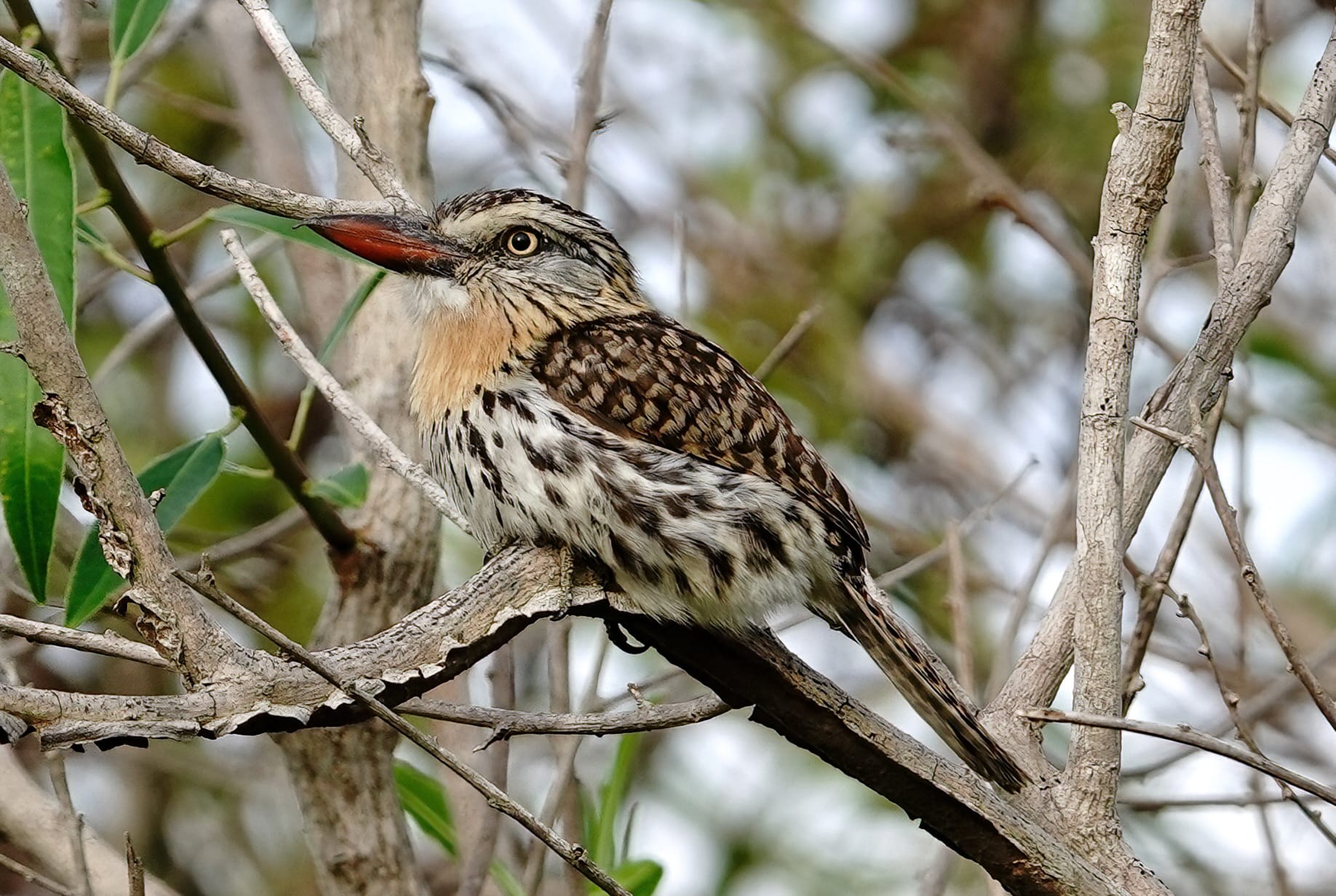
Spot-backed Puffbird
afternoon – it is really hot here and yet they think its a good idea to start as late as 7am so you only get about 2 hours in before having to retreat to air conditioning.
The 2nd day was better because we had a great boat driver who knew where things were (great views of Sungrebe and Sunbittern) and we insisted on going out early, so we had tapirs swimming across the river.
In the evening, we did a night drive for nightjars -and while there were lots of them because our guide knew nothing it was quite frustrating.
Southwild Pantanal Santa Tereza Lodge
Days 33 & 34 We left on the 3rd day for a log, bumpy drive to Port Jofre and a boat to our next location – Southwild Flotel. The boat itself was nice because it is new but based on the current level of management, it isn’t going to be great for long!
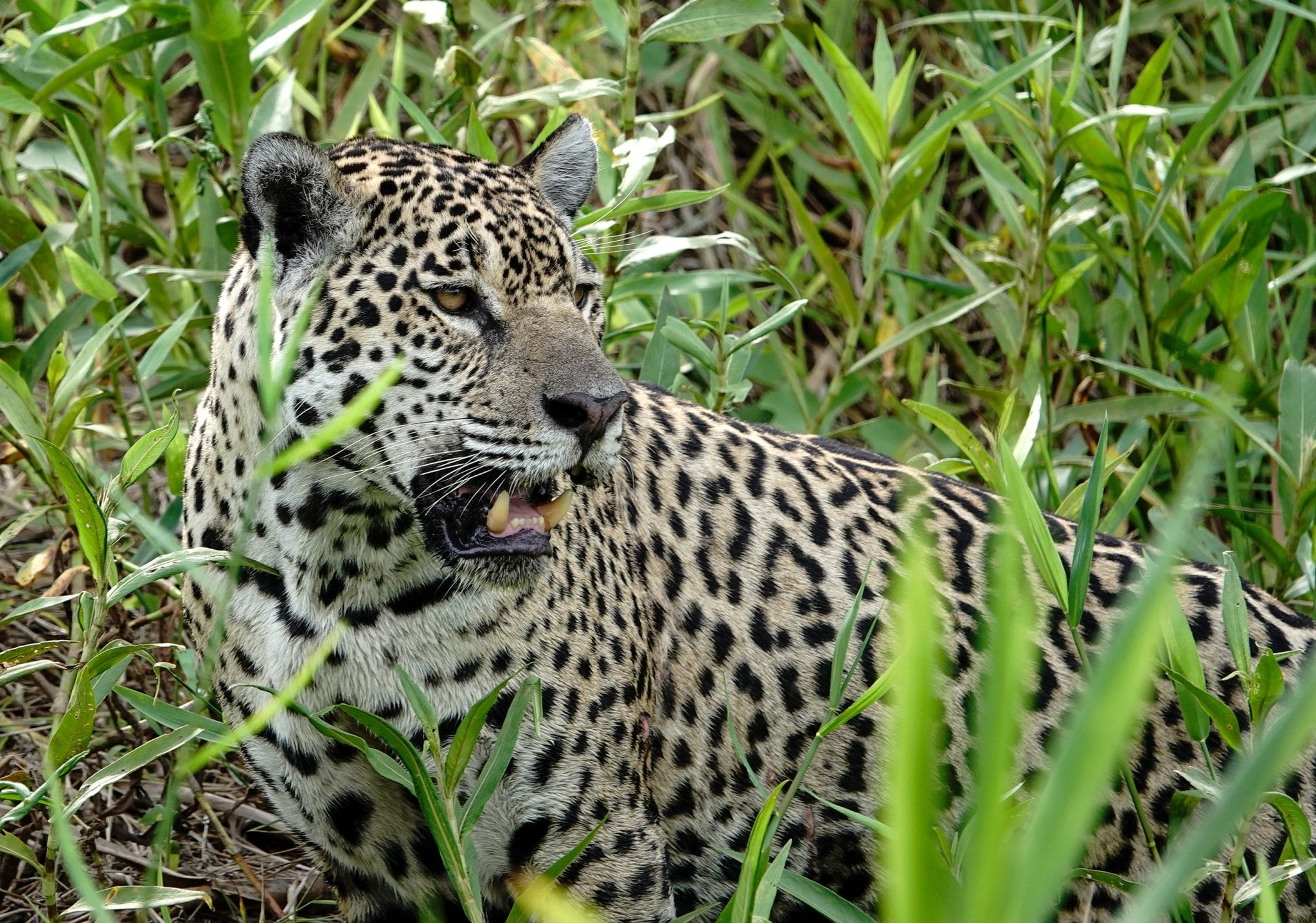
Jaguar
We spent the next 2 days doing river trips to find jaguars – they are magnificent animals and we were blessed with great views of a number of them. BUT BE WARNED – there are dozens of boats out there with you and when someone finds an animal they all rush to the same spot so it really isn’t the nicest of experiences. The other thing I would say, is that it was completely mad because they send people out on boats for hours at a time in 40c+ with NO COVERS. Not only is it not enjoyable it is dangerous.
Birding was OK on the river, all the usual herons and kingfishers but because you can’t land it is tough to get a great list. The only lifers for us in the 7 days we were in the Pantanal were Chestnut-bellied Guan, Red-throated Pipin-guan and Plain-crowned Spinetail – so not really what we had been told.
That wrapped up our long trip.
For the entire trip we managed 651 species of which 251 were new for us taking the grand total of our life list to 6,529.
Hotels
Sao Paulo:
Grand Mercure São Paulo Ibirapuera
Melia Paulista
Manaus:
Hilton Hotel
Novotel
Presidente Figuiereda:
Mari Mari Resort – NOT RECOMMENDED but you don’t have a great deal of choice!
Manacapuru:
Cirandeira Eco Resort
Novo Airao:
Amazonia Park Suites
Rio de Janeiro:
Linx Galeo (Airport hotel)
Santa Teresa Hotel
Atlantic Forest:
Reserva Ecológica de Guapiaçu – The Lodge Regua
Eco Lodge Itororó
Campo Grande (The Pantanal):
Pousada Aguape
Pantanal – Southwild – NOT RECOMMENDED
Guides & Resources:
Guides:
The Guiana Shield (Manaus): Julián Quillén Vidoz – Julian is a close friend and is without doubt one of the very best guides we have birded with anywhere in the world but apart from selected tours he does each year, he does not readily offer guiding services.
The Atlantic Forest (The Lodge Regua): We used the resident guide – good bird knowledge although not great English
Eco Lodge Itororó: We used the guiding company attached to the lodge – they were excellent.
We also used Irmãos Mello Birding Tours who were also outstanding.
Field Guide:
Field guides for Brazil are poor – we used: A Field Guide to the Birds of Brazil by Ber Van Perlo
Keep In Touch